Skip to content


IDEO – The Art of Innovation – book review

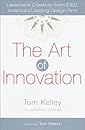
A few weeks ago I finished reading The Art of Innovation: Lessons in Creativity from IDEO, America’s Leading Design Firm by Tom Kelley, Jonathan Littman, Tom Peters. This is a book I’ve heard referenced in many different contexts. IDEO is a firm world famous product design firm; their work is at the Cooper Art Museum in NYC. I was also inspired to read it because IDEO is just down the street from where I live — it’s a place that where I’ve dreamed of working.

At the halfway  point I thought it was a good read. Being an innovative company requires changing the way we work – can most companies do that? Letting go of authority and creative, “hot”, teams is essential. The descriptions of the work environment and culture at IDEO had me thinking about where I wanted to work next. If you want to imagine a place that is hardworking and respects creativity — read this book.

After finishing the book I think the best parts are in the first half — descriptions of how to do brainstorming and how to create hot teams. A good read for those 2 sections.

A couple insightful quotes:

  • “too much square footage, like too large a budget can dissipate energy and discourage more immediate emotional connection.” (p.82)
  • “success at innovation is like putting together the perfect golf swing” – there are 17 things to get right, each one simple on its own, but it’s complex to put together in real time.(p.293)

Overall I enjoyed reading this book, though I found many of the stories repetitive — as if they were cobbled together from many different essays and presentations. It needed a good edit.

Brainstorming Rules:

  1. Sharpen the Focus – ask edgy, tangible questions that focus on the customer need
  2. Playful Rules – don’t critique or debate ideas, go for quantity, encourage wild ideas, be visual
  3. Number Your Ideas – help to set a goal for quantity (i.e., go for 100)
  4. Build and Jump – keep the energy up, jump back to an earlier path, encourage small variation
  5. The Space Remembers – power of spatial memory, process of capturing ideas (facilitator whiteboard), physical movement around the space
  6. Stretch Mental Models – warm-ups, content-related homework (background lecture, toy stores)
  7. Get Physical – sketching, mind mapping, diagrams, stick figures, bring in objects, build things, bodystorming

Hot Groups: groups at IDEO are often ad-hoc, often come together on a project-basis and availability. Below are listed types of characters that can be key to “hot” teams.

  1. Visionary
  2. Troubleshooter – doesn’t suffer fools gladly, fix-it person
  3. Iconoclast – contrarian
  4. Pulse-Taker – heart person, making a personal connections
  5. Craftsman
  6. Technologist – a maven
  7. Entrepreneur – often goes off and creates sub-teams or companies
  8. Cross-Dresser – self-educated, self-motivated, enthusiastic

——

Posted in book reviews, business.

Tagged with , , , .


Social media acceptance

As one of those people who was initially resistant to social media, I can understand an audience that doesn’t want to experiment, just doesn’t get it,  can’t be bothered, and who don’t want to be connected all the time.

Three things on shifting your audience & leadership:

  • Create the time to play with the media
    • I left my job. I had time to play. I really didn’t want to get engaged in social media but felt like I should. At my previous job, we had tried to play with social media within the organization but it was a limited closed circuit. What we should have done, is played with social media in the world wide web — where it’s more dynamic, where you can participate in existing communities.
    • Informal company communications – I wish Twitter was more popular before I had left my job. It’s the one way I can imagine people on different floors keeping up with each other (cross-floor communication became an issue). It would have closed the physical space that opened up after we moved to new offices and the informal chatter lessened. It would have decreased the space between offices in NY, Durham, London. Or people offsite communicating how a client program is going (For example, I could have really used Twitter the time when our a video got held at Canadian Customs and my boss got held at Immigration — I felt very alone.) Twitter would have improved informal communications within our organization. These are spaces where  Twitter can play and help people do their jobs.
    • It depends in part on the type of work and group dynamics of your organization.
  • Provide constraints – let them ease into it
    • There is one thing that got my into social media through blogging: it was Karl Kapp’s line “every learning professional should blog, if only for a month”. Blogging for a month — that I could do. I was participating in Work Literacy in Fall of 2008. I started to blog and it changed my connection to my work and opened up a community of support. Every learning professional should blog — about something they care about — if only for a month.
    • Others should be asked to comment on your blog — only for a month.
    • Rotate the blog contributors — so they each do it for a month.
    • Maybe  monthly/weekly team reports should be done on a blog.
    • Tweet once a day to a community of practice such as #lrnchat, #astd, #dl09, #learntrends – and follow the conversations/hashtags for that community to see if one learns anything new.
  • Get influencers within the resistant cohort and/or leadership
    • I remember trying to teach Second Life (SL)to senior executives. The one question I always got was “Why should we bother, it’s not real.” So I positioned the economy of SL and other virtual worlds as emerging economies. How large (in USD) are these economies? Is this a place where you want to have a presence? How do you regulate in this emerging economy? What are the opportunities? Risks? Are you clients here? (That one always got them.) Are your staff here?
    • Teaching social media to leadership or anyone in the company I would ask similar questions. Social media is in part a reputation/branding engine. What are people saying about your company? Your brand? Are your staff here? Are your clients or customers here? Don’t tell them all, let them discover most of the answers for themselves. Call it research, call it discovery learning.
    • Examine those places that we don’t usually think of as social media — Amazon, photo sharing sites, Yelp, Ning, Delicious. I thought because I didn’t participate in Blogs, Facebook, Twtitter, LinkedIn that I wasn’t on social media. Not true
    • The harder thing to do is find measurements of social media learning that matter to your organization. Is there a pain point you can link social media to (customer complaints, etc.)? Is there a way you can measure the impact of social media?

Social media is a way for the learning department to have an impact beyond just learning and link it to the organization as a whole. It’s informal.

Just some thoughts.

Posted in ASTD big question, social media.

Tagged with , , , , , , , .


Test before you teach – new research on learning

Recently Scientific American came out with an article called Getting it Wrong: Surprising Tips on How to Learn by Henry L. Roediger and Bridgid Finn (Roediger is a cognitive researcher who researches testing, spacing intervals, and repeated retrieval practice being key to long-term retention).

At it’s essence this article says a very simple thing — asking learners hard questions before engaging with the content, (i.e., by giving them a test) challenges learners to come up with an answer before they read the material or listen to a lecture, thereby improving recall of the material. That means not giving people the answer before they engage. That means expecting them to get it wrong, expecting them to fail.

Instructional designers often do the opposite. Give people the model or the answers, then test them. What if we were to test them first with hard questions? That would force people to think! To generate and hypothesize for themselves and begin to engage with the material. But that’s not what ID’s are suppose to do, right? It’s our material and instructional design that shows the way to enlightenment. How can learners be expected to know the answer before they see the material. They will probably get it wrong — and that’s ok. Getting it wrong helps people learn — people learn from their mistakes.

The author’s suggest the following study tactic:

Students might consider taking the questions in the back of the textbook chapter and try to answer them before reading the chapter. (If there are no questions, convert the section headings to questions. If the heading is Pavlovian Conditioning, ask yourself What is Pavlovian conditioning?). Then read the chapter and answer the questions while reading it. When the chapter is finished, go back to the questions and try answering them again. For any you miss, restudy that section of the chapter. Then wait a few days and try to answer the questions again (restudying when you need to). Keep this practice up on all the chapters you read before the exam and you will be have learned the material in a durable manner and be able to retrieve it long after you have left the course.

The technique they describe above is similar to the PQ4R (preview, question, read, reflect, recite, review) method for study materials – except they suggest: preview, question, test, then the 4R’s. The key difference being the test. It’s also similar to asking “why” questions to get people to engage with the material.

This research makes sense but elicits a bit of a “duh” response (“I needed research to tell me that?!?”).

What this research does not address is motivation and relevance  — people can go through the motions of taking a test, of asking “why” questions and still not really engage. Challenging test questions may get some students to engage, but is not panacea. It is a simply method that may work in certain circumstances — what would be really helpful to better understand those circumstances.

My takeaways:

  • test before you teach to challenge learners
  • use hard questions
  • allow learners to get the wrong answers
  • let them find the right answers
  • test again

Posted in cognition, instructional design.

Tagged with , , , , .